July 3, 2026
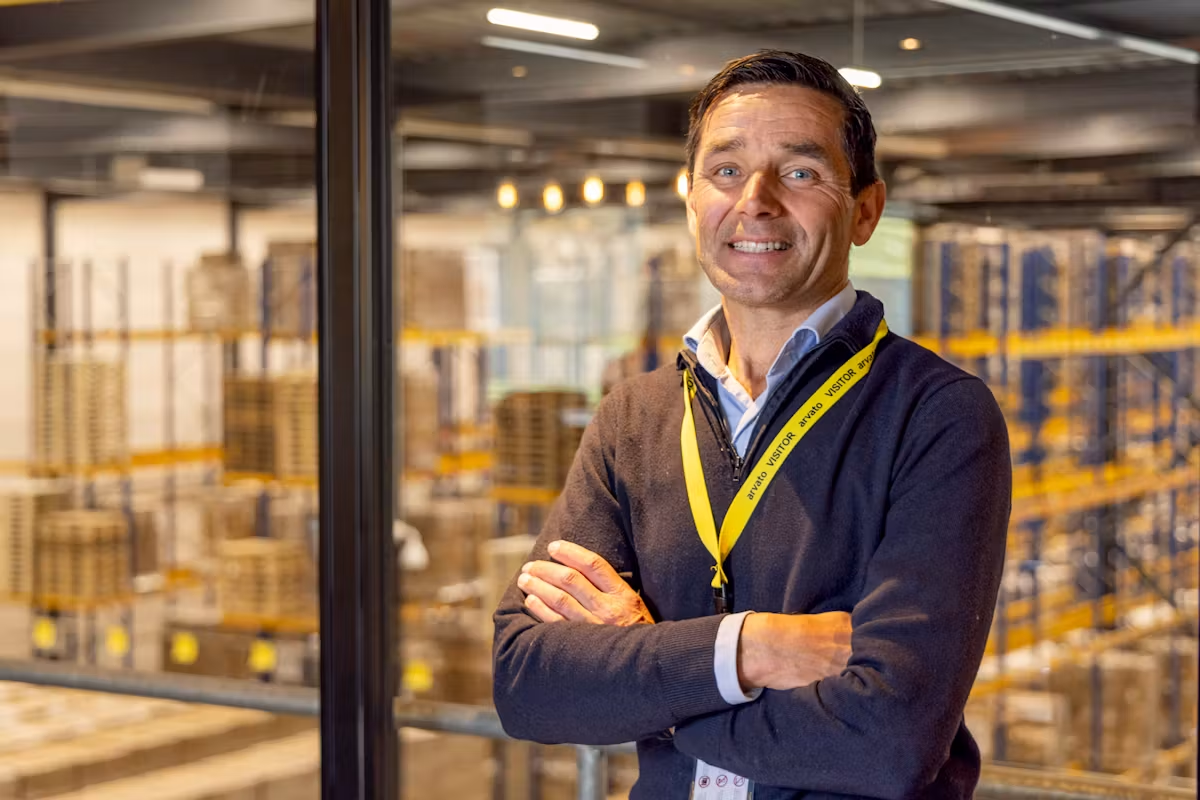
As a Smart Warehousing judge for the Top 100 Logistics Service Providers, I had the pleasure of reviewing this year's entries alongside two colleagues. The podium, with DHL Supply Chain taking the top spot once again, is hardly a surprise. However, the shifts and scores across innovation themes are creating quite a stir, writes Willem Mulderij. The use of AI is by far the most striking development, as is the expectation that this digital revolution holds the answer to many of our challenges. AI has become the magic word, and as the saying goes, "money is no object."
But are expectations perhaps running too high? Of course, the technology has enormous potential, but success hinges on data quality and its practical application: which is often the deciding factor in warehousing. Especially with the growing influence of disruptions, it is unpredictable and difficult for service providers to control. What has become the standard among the top 20 is the integration of software with applied mechanization. A modern WMS that works seamlessly with shuttles, conveyors, or AMRs is now operational in many places. Mid-sized and smaller providers really need to focus on this, and we are already seeing some great applications and entrepreneurial vision in that space.
The real differentiator today is how effectively a service provider can collaborate across the entire supply chain. A warehouse that not only runs efficiently internally but can also truly anticipate customer demand dynamics (including available transport capacity) is what really makes the difference. And don't forget the forecasting of inbound flows, which often remains overlooked. I read some excellent examples of this as well. I had the opportunity to interview Nunner Logistics, and I left feeling pleasantly surprised. AI is a genuine focal point for this provider.
I want to emphasize that innovation doesn't always require multi-million dollar investments. We saw some wonderful and highly practical examples. For instance, analyzing walking and driving patterns in a warehouse and combining that with the expertise of experienced staff can immediately lead to shorter distances and higher productivity.
Here in "The Netherlands Distribution Country," we still have many "man-to-goods" operations, even in warehouses that are partially mechanized. Reducing the distance employees travel on foot or with equipment every day is perhaps the most concrete and lasting efficiency gain. However, with dynamic demand patterns in both volumes and product ranges, this requires constant attention.
And this is exactly where I see the real role of AI in Smart Warehousing. Not just in self-learning picking robots, but in making data analysis and forecasting smarter and truly self-learning. If AI helps us make better predictions and learn to recognize patterns in customer demand, and we combine that with human expertise on the client side, we finally have a dashboard we can act on. I use that word deliberately; it’s about more than just information. Professionals will need to take action to translate all that data into results on the warehouse floor.
Smart warehousing is not a race to see who can acquire the most technology. The true leaders combine AI technology with the practical experience of their teams. It is precisely that combination that makes warehousing in the Netherlands not only smarter but also more sustainable and ready for a future that will likely remain full of disruptions for some time to come.
UC Group works everywhere: our professionals are based across the Benelux. We welcome visitors at our offices in Rotterdam and Nieuwkuijk. Drop by for a coffee and get to know us!