September 27, 2018
Supply Chain Resilience isn't a popular topic among SME directors. When business is good, they don't want to think about it; if the supply chain is 'on fire', they're too busy 'putting it out'.
UC Group developed the Supply Chain Resilience Scan specifically for them. It quickly reveals your vulnerability to disruptions and your ability to respond. What you do with this insight is a secondary concern, but it's certainly the minimum management should know...
Houthi rebels attacking cargo ships in the Red Sea, causing major supply chain delays. A trade blockade between Europe and China preventing you from selling your products in China. Severe weather in Africa leading to crop failures and farmers being unable to deliver. These are just a few examples of recent incidents that have had a major impact on companies operating in these regions. We are, of course, also familiar with much larger disruptions such as pandemics, raw material shortages, climate change, and labor shortages due to an aging population. Companies that face the most problems as a result of these events have one thing in common: they are unprepared.
To arm yourself against Supply Chain risks, a company must first accurately measure two things: a) What disruptions are you facing and how vulnerable are you to them? and b) To what extent are you able to react to such a disruption so that it doesn't become catastrophic for your company? These are questions that UC Group has already helped many companies answer, and for which we developed the Supply Chain Resilience Scan. With this analysis tool, a company quickly gains insight into its weak points and what management can do to strengthen them. For clarity: the scan itself doesn't make you resilient; it only shows where the risks lie and what *can* be done about them. It's a beginning, the starting point towards a future-proof Supply Chain.
The strength of the scan is that it considers all facets of Supply Chain Vulnerability. For example, as a manufacturing company, are you dependent on scarce raw materials or components that only one supplier in the world can produce? Then that's an indication of a vulnerable supply chain. Do you have a labor-intensive warehouse with many employees? Then you are more susceptible to an aging workforce or a pandemic.
Also in terms of Supply Chain Capability the scan provides a complete picture. To what extent are you able to mitigate risks? For example, do you share a lot of market data with your customers and have a good forecasting process? Then you are less vulnerable because you anticipate changes in demand at an early stage. Are you able to quickly onboard new suppliers or relocate production from Asia to Europe? Then you can react more quickly to a disruption in China.

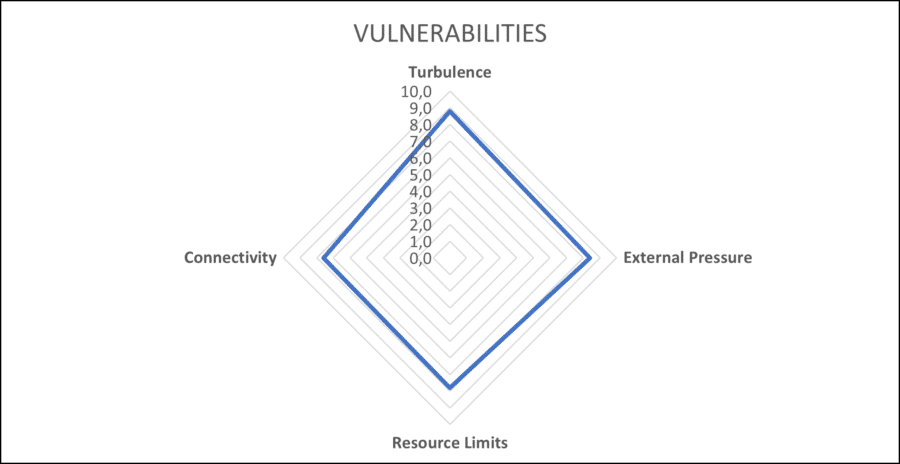
Implementing the resilience scan has already led to interesting results for UC Group's clients. Management became aware of risks they had previously overlooked or whose impact was much greater than expected. For example, a pet food producer turned out to be completely dependent on a specific raw material from Australia and had not sufficiently considered alternative suppliers from other parts of the world. An important effect of the scan is that it fosters productive discussions within a company. The spider diagrams serve as a "discussion tool" to align departments, mobilize the right knowledge, and jointly determine priorities. What risks require precautionary measures, and what should those measures look like?
Unfortunately, completing the Supply Chain Resilience Scan does not mean your company becomes 100% invulnerable. This is simply not possible; resilience is a relative concept, and you can never exclude all risks or be immune to them. Furthermore, significantly reducing business vulnerability involves substantial costs, and it's questionable whether these outweigh the benefits. For example, developing an alternative supplier network in Europe to reduce dependence on China is simply unaffordable for many companies. Supply Chain resilience is therefore also a matter of calculating probabilities and spending your money wisely. It can be a conscious choice for a company to prepare only minimally for a new pandemic, for instance, by just creating a contingency plan.
Our advice is to give resilience a permanent place on the Supply Chain agenda. Creating a robust Supply Chain is not a one-off project but a continuous process. The scan can be repeated annually to identify new risks and determine if you are still setting the right priorities. This certainly doesn't always have to lead to major improvement projects; even creating a scenario plan can yield significant benefits. Just the fact that you don't panic during a disruption but can fall back on a step-by-step plan makes a big difference. Large companies often have this well-organized, but for small and medium-sized enterprises, this is often a blind spot. For them, there is now the Supply Chain Resilience Scan.
This article was written by Johan Omvlee and Lars Jan Hekkelman of UC Group, both members of the Logistics & Supply Chain Resilience-tribe of UC Group. They have extensive experience with Supply Chain Resilience; Johan primarily from a management role and Lars Jan as a process engineer. The logistics experts at UC Group specialize in designing and optimizing Supply Chain concepts, particularly for medium to large-sized companies. The ability to handle major societal changes and significant disruptions is gaining importance in this advisory role.
UC Group works everywhere: our professionals are based across the Benelux. We welcome visitors at our offices in Rotterdam and Nieuwkuijk. Drop by for a coffee and get to know us!