July 3, 2026
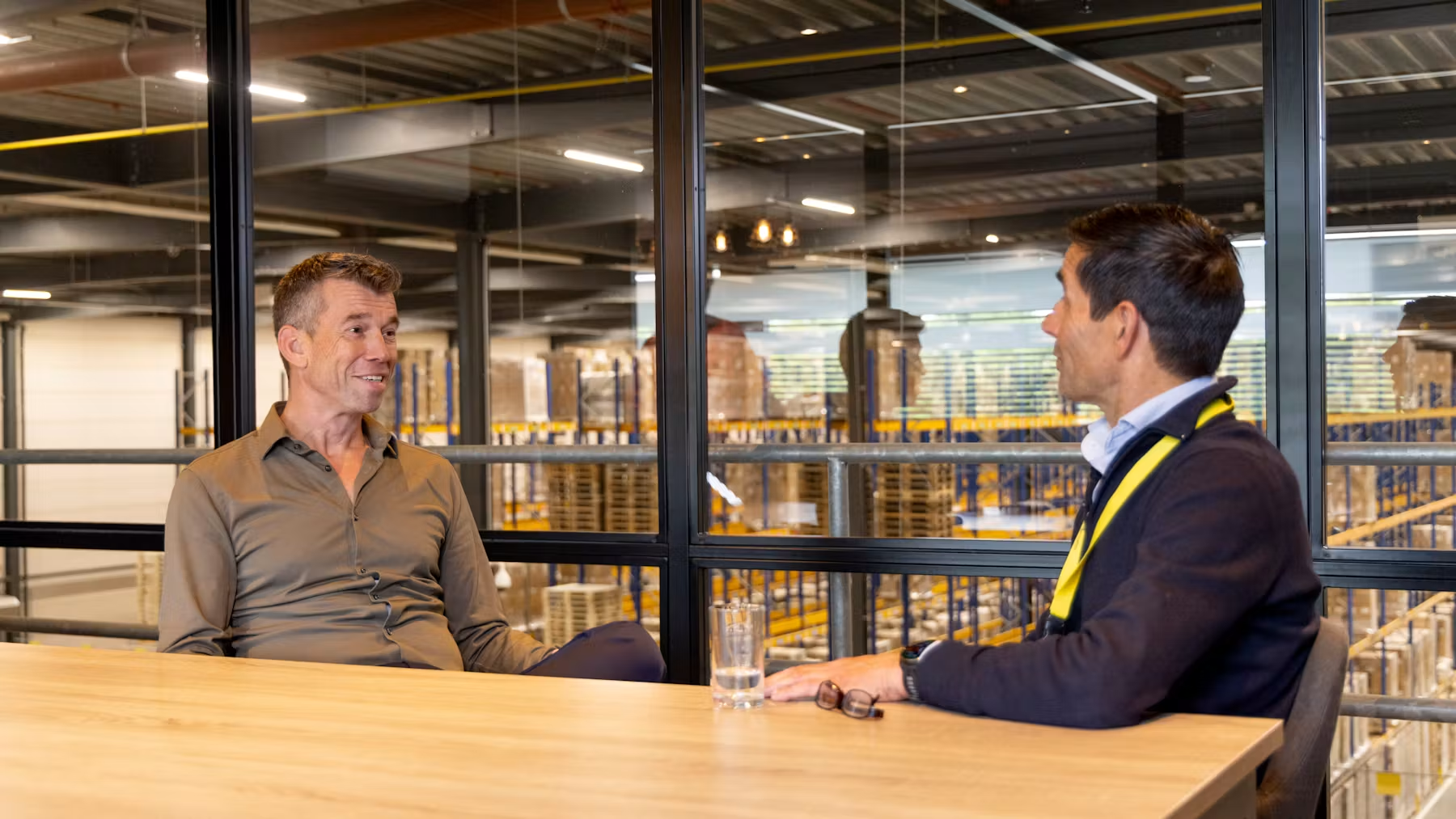
AI has been a buzzword in logistics for several years, but what can these smart programs, algorithms, and agents actually do for the sector? Willem Mulderij of UC Group, also a jury member for the Top 100 Logistics Service Providers, sits down with Martijn Nielen, director of Arvato's Dutch branch, to discuss artificial intelligence, automation, and robotics.
Arvato's warehouse in Heijen, Limburg, is massive: over 200,000 square meters. The logistics service provider serves clients active in electronics, consumer goods, and the technical and pharmaceutical sectors. One of the halls houses an Autostore system to process orders for wellness products, while another area features a Knapp shuttle system for a Japanese electronics manufacturer.
Because of that knowledge and experience with various warehouse systems, and because the company finished last year in 11th place in the Top 100 Logistics Service Providers ranking, Arvato is the ideal candidate for Willem Mulderij to take a look inside. Mulderij is a co-owner of UC Group and a jury member for the Top 100 Logistics Service Providers. He wants to know from Arvato director Martijn Nielen what AI and new technologies are actually adding.
Mulderij: "One of the areas we want to test against the market is AI. I wouldn't call it a hype, but it is, of course, a technology that has suddenly become available to everyone. What was your vision on that?"
Nielen: "We had to learn how to deal with it. What do you do and what don't you do? For us, smart warehousing isn't just about installing a robot, an Autostore, or a conveyor belt . It's about the whole picture. But it's also not a magic wand. It has to be integrated: automation, data, and analytics."
Ultimately, you are focused on the customer. And the customer's demand has changed: the speed they require, the peak loads, the omnichannel needs. The pressure to be better than their competitors is enormous. We have to be able to keep up with that. Smart warehousing and AI help with that very effectively.
For example: if you have an Autostore, but your ABC analysis isn't in order, you'll have a problem the next day. Your fast-moving items will be at the bottom, and the robots will just be digging and digging while your employees are waiting at the packing tables. Especially in that area, with the planning of employees and orders, we see that it is very tangible and is increasingly moving toward robotics. But AI is not a silver bullet that makes everything better; you have to integrate and maintain it."
Mulderij: "But has AI really been able to do anything there yet? With an ABC analysis in Autostore? Because you could say: that customer sends an order before 10:00 PM to be picked the next day. And the Autostore algorithm already had the capability to transport the bins for that to the top during the night. Has AI really brought added value there?"
Nielen: "Yes. We really see that we can use it in those areas. And regarding employee scheduling, we really see that it helps."
Mulderij: "Is it then smarter or faster, or can it process data more easily?"
Nielen: "Yes, smarter. Also because it learns. It learns from what happened in the past and how that can be improved. We are currently working on what we call a digital twin call it. If you are working on a complex implementation with a difficult operation, you can run it through the system to see how it works. But AI can ultimately improve it, too. So, it’s not just about identifying where things will get stuck or where you won’t hit your KPIs, but actually helping with what you can do to improve them.'
Mulderij: 'Do you load such a system with libraries from new systems as well?'
Nielen: 'Absolutely, that is the strength of the fact that we handle so many operations. We have a vast amount of data, and we can use that for analysis.'
Mulderij: 'When I look at models in the construction industry, they are already a step ahead of the logistics sector. We still do a lot manually. If an engineer changes something in a setup, they have to think about which other levers to pull or where additional capacity is needed.
That is already prepared in building models. Everything changes integrally there. Such a model knows: if you want to run an extra 4 meters of piping somewhere, an extra switch or transformer is required. In logistics, that is still fairly fragmented; a lot is still done manually. So, you need an experienced engineer to design that properly. I see building models as the next step we could move toward.'
Do you also use plugins from a supplier that can, for example, already pass on new specifications?'
Nielen: 'We want to remain independent. That is what our customers expect from us. There is also a procurement component involved, because those machines cost millions, tens of millions of euros. But we also don't want to work with ten different AutoStore suppliers. We work with three, globally. We collaborate very closely with them because, for instance, in an RFQ phase (the phase in which a potential future customer requests a price quote, ed.), everything has to be right immediately. You have to have your price ready within four weeks. You can't come back later and say you made a few mistakes and that another 10 percent needs to be added. That’s not how it works. So, in that RFQ phase, you have to be able to collaborate very closely with a number of suppliers to present a solid offer to the customer. That integration with the supplier must be seamless.'
You have to have your price ready within four weeks. You can't come back later and say you made a few mistakes and that another 10 percent needs to be added. ”
— Martijn Nielen
When you do something like that for the first time, it’s almost impossible for it to go perfectly. We also made mistakes with our first AutoStore. We spent almost two years getting it to where it needed to be. That takes blood, sweat, and tears. It was painful, but it also taught us an enormous amount.'
Mulderij: 'Did AutoStore take those lessons back to improve the algorithm of their warehouse control system?'
Nielen: 'We are working on other projects as well, which is how we know that not all the important lessons we identified have been incorporated. We do point that out.'
Mulderij: 'And have you already made a choice regarding which AI system to use? You are, of course, being flooded with new techniques. First it’s ChatGPT, then Claude, then we get agents that are trained and even smarter. The choice is overwhelming.'
Nielen: 'We use Copilot for certain parts, but we are still figuring it out. We work a lot with Microsoft globally. We are one of their key suppliers, and they are one of ours in terms of systems.'
At Arvato, we have separated AI and robotics from standard IT and have a test center in Poland, where we test humanoids, for example. Unchained Robotics, in which we recently acquired a stake, is also part of that. It sometimes looks beautiful, but for us, it’s about how you make it work in the operation. That doesn't always succeed.'
Mulderij: 'You can't foresee everything in advance. I have done many WMS implementations, and in every project, you run into a number of unforeseen issues. Could you have tackled that with a test or go-live preparation? Sometimes you just flip the switch and dare to take the step.'
I have done many WMS implementations, and in every project, you run into a number of unforeseen issues. ”
— Willem Mulderij
Nielen: 'There isn't a project you don't learn lessons from. But when does a project become AI? When is it smart warehousing, what are smart systems? Do bots count too?'
Mulderij: 'I always consider self-learning an important criterion for AI. We already had very smart algorithms, where people were still optimizing with the most sophisticated mathematical models. I test AI against self-learning.'
Nielen: 'In order planning, prioritization, and staff scheduling, we see it becoming truly self-learning. We don't always make it easy for ourselves as a country. Flexibility has declined due to WAB legislation. You have to schedule employees for time slots four days in advance; if you deviate from that, you still have to pay for the extra hours they don't work.
That’s where you see that the models have improved and are self-learning to handle those elements much better. Ultimately, you save costs because you have fewer idle hours. We can have a lot of idle hours if a client's planning is off. You can't pass those costs on to the client because flexibility is expected of us.'
Mulderij: 'And where will the warehouse operation be in five years?'
Nielen: 'Much further along. I don't believe in running the operation entirely without people in five years' time. However, I do think we will have further reduced the less pleasant, strenuous activities for employees. The operation will be more efficient because we will have been able to train employees further on new tools. That makes it more enjoyable for people. I truly believe that.
Especially for heavy and repetitive work, there are many opportunities in robotization. We still have people here who loose loaded containers unload. Just box by box. We have to do that differently. Nobody wants to do that work anymore. You want to do that work with robotics.
We still have people here who unload loose loaded containers. Just box by box. We have to do that differently. ”
— Martijn Nielen
Experiments are already underway. With our stake in Unchained Robotics, we want to have more influence on what is being created there, and we want to be at the front of the line to purchase those products. Then we can start using that robotization much faster. Our goal is 10,000 robots by 2030. You need a bit of pressure to get that done.'
Mulderij: 'That could also be an answer to the staff shortage and a way to make our sector more attractive. It is a challenge anyway to distinguish yourself as a logistics sector among the hundreds of higher education programs that exist. The use of many English terms already makes it unattractive to some students.
With robotization, you make the work more innovative and attractive, both for those entering the warehouse unskilled and for the higher education graduate. You have to embrace high-tech to stay in the game.'
Nielen: 'You do need super-intelligent, experienced engineers now who can handle tools to set up the best operation. But you are also going to ask much more of the operator. You want to use people for more intelligent tasks. You have to learn that, too. At Autostore, we also had to learn how to resolve 95 percent of the downtime ourselves. That is a different task, a different role within that group. They now solve 95 percent of the problems themselves, the technical service department handles 4 percent, and the external supplier handles 1 percent. We all had to learn that.
I find that very enjoyable, too. There are many people who want to progress, and they can really make strides. That’s what I find beautiful about logistics. Even without degrees, you can move up if you have the will and the motivation to get somewhere.'
UC Group works everywhere — our professionals are based across the Benelux. We welcome visitors at our offices in Rotterdam and Nieuwkuijk. Drop by for a coffee and get to know us!