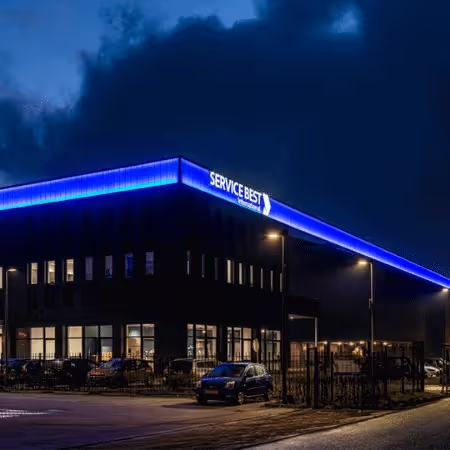
Customer challenges
Service Best International, a wholesaler and market leader in car and bicycle accessories, has grown strongly over the past ten years. This continued growth and the company's desire for more professionalism were reasons to switch to a new WMS. This, together with an unfortunate coincidence, put additional pressure on the company's operational organization and led to a request for direct management support from UC Group just before Christmas. The main objectives were to restore the warehouse's performance to the desired Service Best level in the very short term and to provide interim management for two temporarily vacant positions.
Approach
To help Service Best achieve its goals, we chose to hire an interim logistics manager with consultancy experience. The approach chosen by the interim manager in consultation with Service Best provided immediate results in the short term, while also taking into account Service Best's long-term needs.
Results
- Within 3 weeks (including the busy Christmas and New Year periods), warehouse performance rose by almost 20% to over 95% OTIF (On Time In Full);
- Translating long-term strategic planning into the concrete operational changes that are necessary for long-term success;
- Strengthening workplace ownership by introducing a system of “assisting foremen” with responsibilities per zone;
- Organizational clarity about who to approach for which questions and tasks, and thus strengthening the focus of the foremen;
- Real-time insight into the warehouse and offices at “last departure times” for orders.
Our solution
- Advice and coaching from line managers: gaining acceptance from Service Best's management for the need for change, both in the short term and on the strategic agenda. Based on Service Best's strategy, front-line management was coached in personal development that is in line with strategic requirements.
- Operational stability: temporarily providing extra capacity made it possible to maintain sufficient organizational rest in the short term. This was combined with adapting and formalizing the organizational structure to recalibrate the organization and establish clear responsibilities, roles and tasks. In each warehouse zone, only 2-3 specific tasks were defined for each supervisor.
- Providing clear management information: producing visual reports on large screens in the workplace to show how many order picks were needed in each zone for each day (past, present, and future), each flow, and each “last departure time”.
- Introduction of operational coordination: a daily platform where relevant internal stakeholders were involved, informed and activated in a clear and uniform way.