Customer
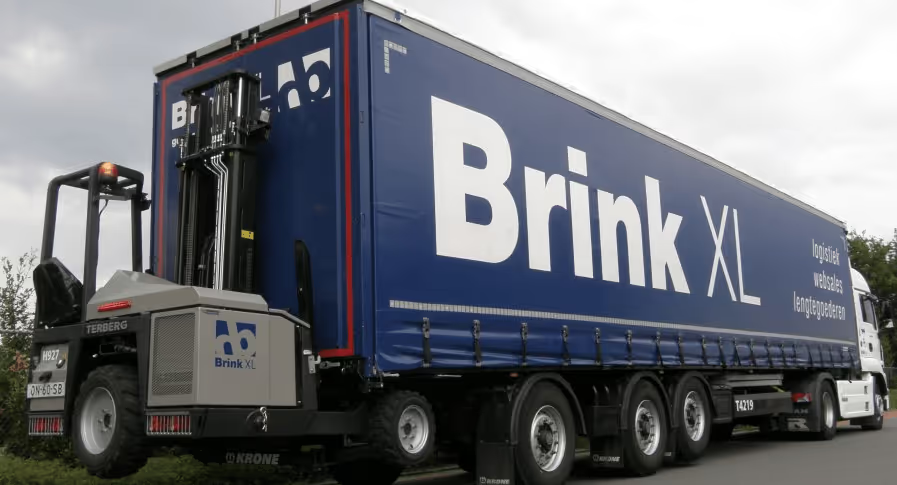
Brink XL
Date
November 14, 2025
Service
This case shows how the management of a transport company came back “into control”. The company focuses on transporting commercial goods with obsolete dimensions and mainly serves construction-related suppliers with a seasonal character. The company's results had been under pressure for some time. Working at multiple locations resulted in loss of efficiency and coordination problems. In addition, various administrative systems, the lack of (real-time) operational data and the lack of management information made control difficult.
Two years earlier, the management decided to invest in a new Transport Management System (TMS) and provide trucks with on-board computers. At the same time, the organizational choice was made for centralization: the transition from autonomously controlled branches to a centrally controlled company. However, this necessary reorganization with re-automation involved many problems.
The transition to central control required a different way of working by both management and staff. The implementation of the new system and on-board computers was slow and did not provide the desired control information during the process. In addition, during the implementation, a customer package was acquired that accounted for 8% of the annual turnover, but took a heavy toll on the operation. Meanwhile, refinancing the company required a lot of management attention, and the company came under special management at the bank.
After the merger of sales and planning at one location, there was still little cooperation, leading to significant losses up to and including July of that year. The administrations were merged in the middle of the year, but this made comparison with previous years difficult. As a result, the management had difficulty setting priorities, and people were swept up in the issues of the day.
The situation was urgent at the start of this assignment. The bank had rejected the proposed plans and threatened to withdraw the credit facility. An interim employee had already been deployed to guide the planners in using the new TMS. However, planners had no insight into the turnover per truck and no incentive to focus on margin. Service came at the expense of load factor. The task was therefore clear: to bring the company back into “control”.
The transport company was in a critical situation with significant losses, inefficiencies and a lack of management information. In order to regain control of the organization, an integrated approach was used. The cross-dock activities appeared to be a major cause of loss due to poor control, leading to loading errors and damage. This was addressed by introducing a single central schedule and actively controlling return cargo, which resulted in better revenue per truck per day. In addition, it was decided to impose a five percent rate increase on customers who contributed less than two percent of turnover.
Experienced, capable board members can also lose control of the situation. In this business case described, it was because too long a tried and tested approach had been built on. In a changing playing field, there was a lack of adequate, timely business information.
The recovery measures were taken opportunistically but did not contribute to greater insight. By helping to interpret available data and converting it into management information, the management was able to set the right priorities again.
The financial situation called for immediate and structural measures. Together with the management, a similar historical dataset was set up to analyse trends in gross margin, turnover per customer and turnover per truck. This revealed that wage costs rose relatively faster than turnover and that the changed order pattern caused inefficiencies. Offers were revised with a higher minimum rate per unloading address, and customers with low margins were faced with a rate increase or termination of the cooperation. In addition, staff costs were saved by strictly applying the break rates in the collective labor agreement, which resulted in a three percent reduction in staff costs. These measures brought structure, cost reduction and improved margins.
Based on the distribution pattern and the geographical location, it was determined which location was most suitable for carrying out the total transhipment. This concentration initially involved additional costs due to changes in the location of drivers and additional upfront costs for distribution to the Northern Netherlands. Nevertheless, the merger provided operational benefits through the scale of transshipment activities and easier management. The new location of the cross-dock was also 50 kilometers closer to the economic center of gravity.
A crucial step in this solution was the sale of the business premises to be closed. The economies of scale of the merger only became fully noticeable after additional travel costs, especially hours, no longer had to be reimbursed. The short- and long-term measures were brought together in a concise plan and successfully presented to the bank by the management.
UC Group works everywhere — our professionals are based across the Benelux. We welcome visitors at our offices in Rotterdam and Nieuwkuijk. Drop by for a coffee and get to know us!